
Creating Lawyers Ready for Anything: Anthony Inglese’s Reflections for the Next Generation of In-House Lawyers
Anthony Inglese CB has spent a career at the heart of government legal services, leading legal teams across five major government departments, including most recently as General Counsel and Solicitor to HM Revenue & Customs. Alongside a distinguished legal career, he has become known for his commitment to developing and mentoring the next generation of lawyers.
This commitment has afforded Anthony a unique perspective on what makes a successful in-house lawyer, the importance of nurturing talent, and how the profession must adapt in the age of AI. He recently sat down with NuCAS to reflect on his career journey, the future of the profession and to share his advice for aspiring and established in-house lawyers alike.
Could you tell us a little about yourself and your career journey, including what first attracted you to an in-house legal career?
My family always strongly valued the importance of education. My father was a tailor. He also taught tailoring at evening classes. My mother was a school welfare assistant. When I would come home from school, my mother would test me on my French or help me rehearse my lines for the school play.
I did well at school, but truthfully, I didn’t know what I wanted to do. One day when our teacher asked the class to share what career path each of us might like to take, a classmate said “lawyer”, and I thought that sounded alright so quickly followed suit. My mother was pleased with that idea and through a friend arranged some summer work in a local solicitor’s office after my GCSEs.
I thoroughly enjoyed my law studies at University. I married just after graduation and stayed on for a postgraduate year, during which I taught Roman Law alongside studies in legal history. During that year, I decided that I would like to be an academic, so I applied for a fellowship but ultimately was unsuccessful. Throughout this process I had however realised that I didn’t really want to conduct research (which a career in academia would almost certainly require), but rather I just wanted to teach, so perhaps it wasn’t for me.
My wife encouraged me to go to see the career advisor, and he suggested that since I liked politics with a small “p” and public service, I should consider joining the civil service and becoming a government lawyer. After first applying to the Law Commission, I was redirected to the Home Office where I joined and subsequently fell in love with the role.
My career from there on was varied and included time spent in the Home Office, Attorney General’s Office, Office of Fair Trading (now known as the Competition and Markets Authority), the Ministry of Defence, the then Treasury Solicitor’s Dept (now the Government Legal Dept), the Business Dept and finally HMRC.
As my career progressed through the different departments, I spent a long time leading large teams and through this I discovered a real passion for supporting young lawyers in their training and development, who were ready for anything. As a leader who transitioned to new departments several times, I learnt that my role was to facilitate the brilliant people who worked for me, rather than trying to know and do everything myself.
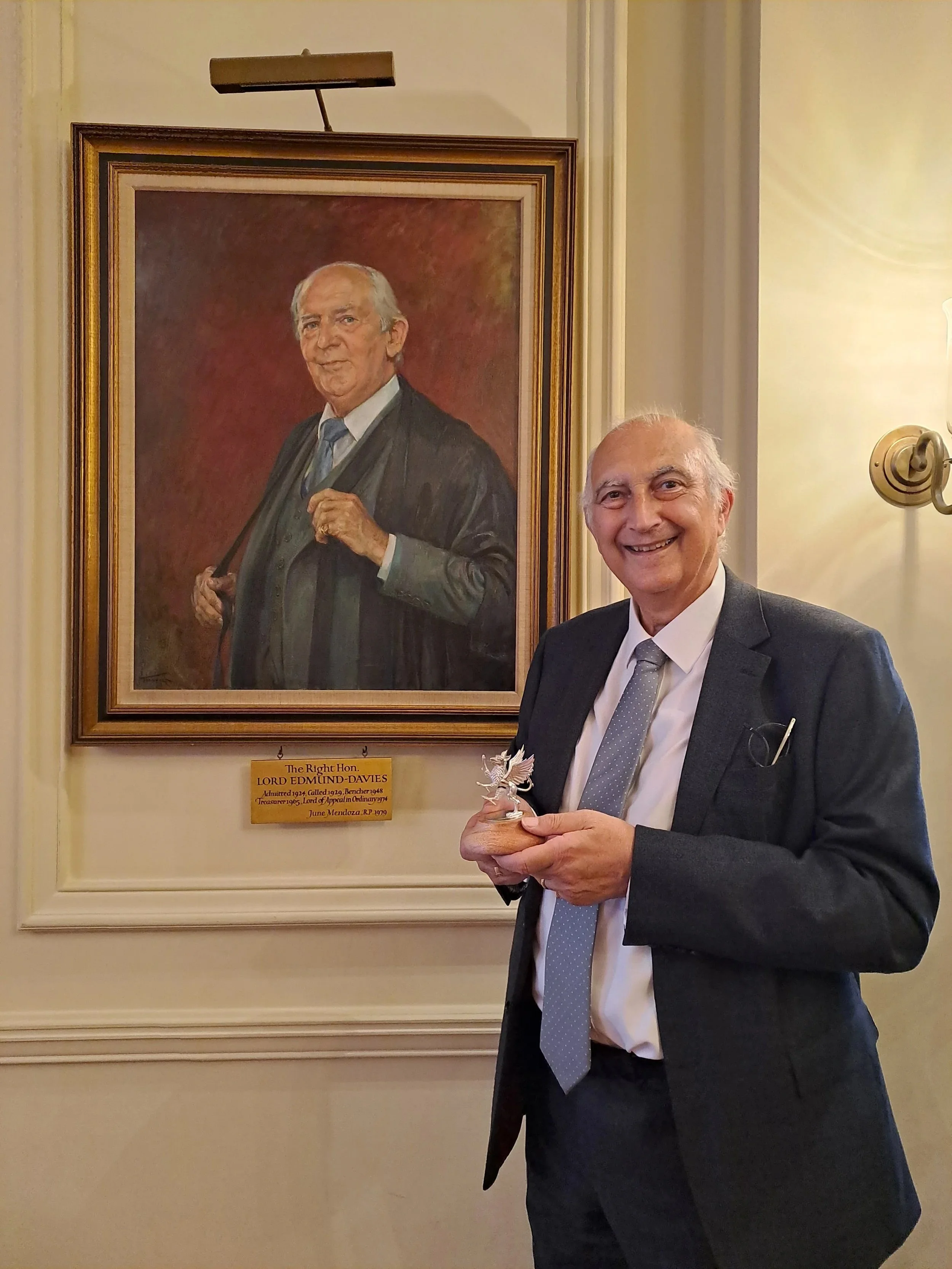
Anthony is pictured holding the silver griffin presented to him at Gray's Inn to mark his call to the Bar 50 years ago. He is standing in front of the painting of the Right Hon. Lord Edmund-Davies who sponsored him on his call night.
Having led large legal teams across a host of government departments, what skills do you believe are most critical for success as an in-house lawyer today?
Firstly, intellect. It’s important to have a genuine desire to get to the heart of a problem and be prepared to look beyond the surface to fully understand the legal issues in question.
Secondly, understanding your client. Whoever your client may be, you need to understand what they really need. Are they asking the right questions? Is there a different or better way to approach the issue? Your client should enjoy working with you, and the goal should be for the legal team not to be seen as a separate function, but as a trusted partner working alongside them.
Teamwork and leadership are also critical in any in-house environment. Leadership is not always about big, visible actions; it is often demonstrated through the small things, such as volunteering to help, taking ownership of a project, or supporting colleagues. Teamwork is equally important. The ability to work effectively with others, both within your legal team and across the wider organisation, is essential.
Finally, altruism. Considering what your role is in helping the organisation succeed. How can I support the development of my team, deliver training, or help my colleagues? Adopting this mindset will make you a valued member of the team, both internally and in the eyes of your clients.
What is the most valuable "non-legal" skill you developed during your career, and how did it help you become a more effective lawyer and leader?
During my time at Business Dept (which I still call the DTI) we brought in consultants to assess our senior leadership team. As part of that process, we completed a number of personality assessments, including Myers-Briggs profiling. The results were quite different from what I expected. They highlighted me as someone who values harmony and has a natural ability to bring people together.
Shortly afterwards, I was asked to step in and chair one of our board meetings. The assessment had helped me recognise something I hadn't fully appreciated before, while I didn't see myself as someone who particularly enjoyed meetings, I turned out to be a good chair. I was able to bring different perspectives together, create constructive discussion and help groups reach decisions.
Once I understood that strength, I actively sought out more opportunities to chair various meetings and over time, I became a trusted chair at the DTI and later within HMRC.
The lesson for me was to seek feedback and development opportunities beyond purely technical legal skills. Be open-minded about what you learn and consider how those insights can be applied across your role.
Mentoring and developing legal talent has been a significant theme throughout your career. Why do you believe mentoring is so important?
People are the strength of any department or organisation. You want to recruit great people, develop them and then let them fly. One of the happiest things for me is to see recruits and former trainees grow, take on senior roles and advance through the profession whether within government or within the private sector. I am still in touch with many of them today.
During my time as a senior lawyer within government, we spent a lot of time on the induction of trainees and new starters. It provided an introduction both to the wider legal service and to the specific departments they would be working in. I always enjoyed participating in those inductions. It gave me the opportunity to get to know new colleagues, but also to help create a welcoming and supportive environment from the outset.
The success of our training, recruitment and induction programmes was the outcome of a real corporate effort on the part of many committed and enthusiastic people.
Ultimately, investing time in people benefits everyone. It strengthens the organisation, develops future leaders and, for me, there has always been a real satisfaction in developing lawyers with the confidence and skills to feel ready for anything.
How do you think the development and training of new in-house lawyers will change in the age of AI?
I hesitate to say much here, as I left active practice many years ago. What I will say is that AI is no more than a tool. The challenge is not simply teaching the next generation of lawyers how to use AI, but how to use it when appropriate effectively, responsibly and with proper judgement.
That means organisations will need to focus on recruiting people who can think independently and approach their work with a high degree of critical thinking. This may require a different approach to recruitment and training. Not every task requires AI, and lawyers must be able to recognise when its use adds value and when it does not.
Lawyers cannot outsource their thinking. AI can help analyse information, identify issues and improve productivity, but it should be used in a structured way to support, not replace, human judgement.
The lawyers entering the profession today will be the supervisors of tomorrow. They need to understand not only how to use AI, but also how to review its outputs and spot when something is wrong. To do that, they must first develop a strong understanding of the legal and commercial landscape themselves.
Those who will be successful are those who balance the efficiency gains that AI can bring with strong judgement, critical thinking and a deep knowledge of their clients and the law.
What advice would you give to current law students and junior lawyers who are considering an in-house career?
I am not usually a fan of giving generic advice, I always think the best advice is given when it is tailored to the individual and their circumstances.
However, my one piece of advice would be this: if you're considering an in-house career, speak to someone who understands the in-house legal environment, or better still, someone working within the organisation that interests you.
Ask them what they like about their job. Talk to them about your strengths and weaknesses, your interests and what motivates you, like you would with a career adviser. Find out about the organisation, will you fit in, does the work and culture align with your expectations.
If those things align, then go for it. An in-house career can be incredibly varied and intellectually rewarding, offering opportunities to build meaningful relationships with clients and make a tangible impact on the organisation around you.
We want to thank Anthony for taking the time to talk to us and share a glimpse into his fascinating career journey. From mentoring trainees to leading some of the largest legal teams in government, his experiences highlight the enduring importance of investing in people.
As the legal profession continues to evolve, particularly with the rise of AI, Anthony's message is critical: technology may change how legal work is done, but the qualities that underpin a successful lawyer, critical thinking, sound judgement and the ability to form strong relationships, will remain as important as ever.